Why Is Testing the Bottleneck Now That AI Writes the Code?
Your developers ship faster with AI and the release still slips. The bottleneck moved to verification, and most fixes aim at code review, the wrong stage.

Your developers just got faster. A lot faster. AI writes a growing slice of everything they ship, features that used to take days land in an afternoon, and the release date still slips. So why does it feel like you are shipping slower?
Because writing the code was never the whole job. Someone has to prove it works, and that step is exactly as slow as it was last year. The queue shifted downstream, to whoever verifies what got built, and most of the advice out there aims the fix at the wrong stage.
What you’ll learn
- Why AI moved the bottleneck from writing code to trusting it
- Why code review is not the same thing as verification
- Why letting AI write the tests relocates the problem
- The one change that lets verification keep pace with AI output
AI Didn’t Kill the Bottleneck, It Moved It
When code generation gets cheap, the constraint moves to the next slowest step, and that step is verification, proving the new code works inside a running product. Speed up any one stage and the queue re-forms further down the line.
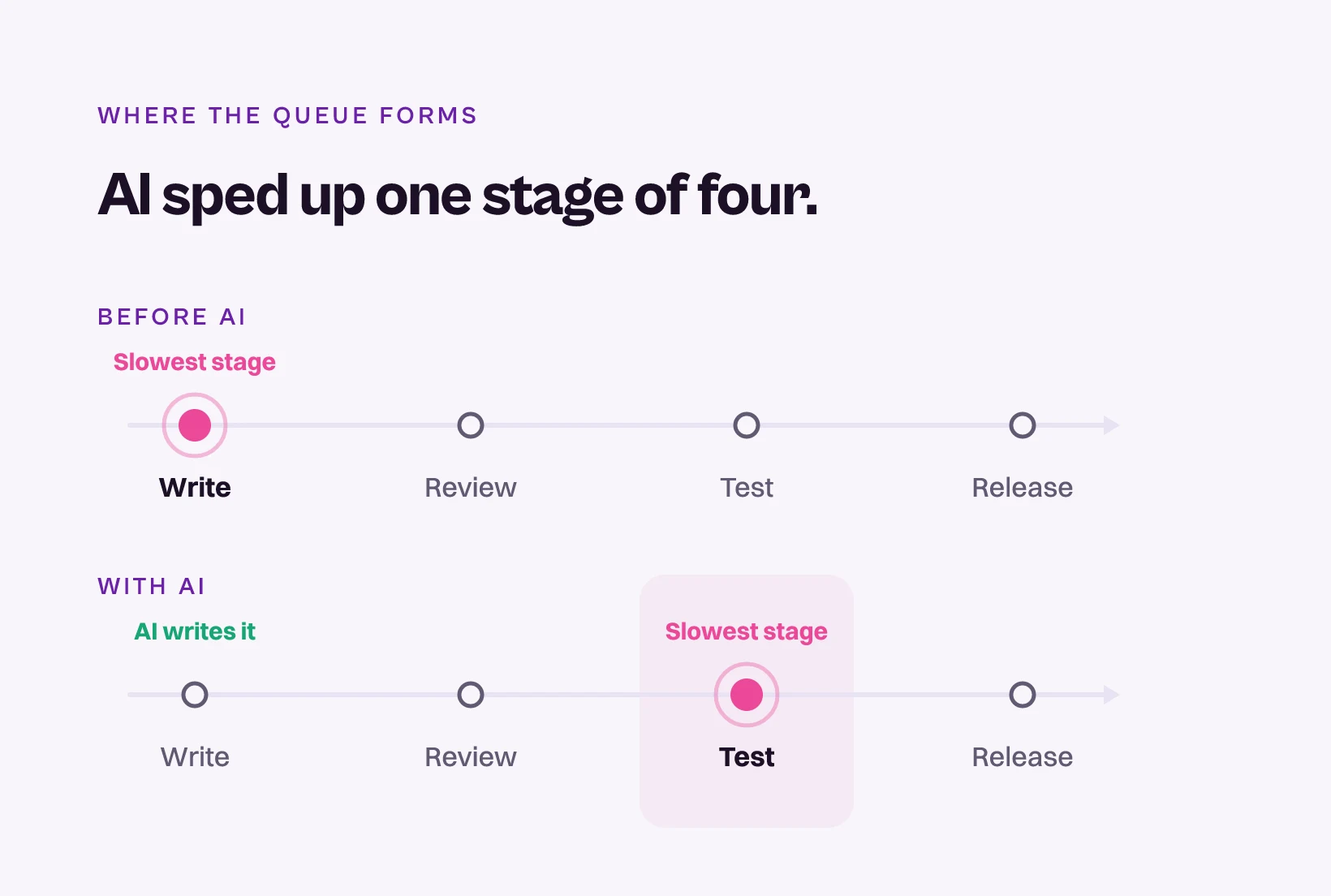
Google’s DORA team measured the shape of it. The 2024 Accelerate State of DevOps Report found that as AI adoption rose, delivery stability fell by an estimated 7.2%, and the 2025 report found it falling again even as throughput turned positive. DORA reads the drop as change volume outrunning the basics, small batch sizes and solid testing, which is the strain a flood of generated code creates. Teams got the speed. Their releases got shakier.
And the flood is real. On Alphabet’s October 2024 earnings call, Sundar Pichai said more than a quarter of Google’s new code was generated by AI, then reviewed and accepted by engineers. By April 2026 that figure was 75%, up from 50% the previous fall.
Notice the clause Google attaches every time. Engineers approve it. When three quarters of what enters a codebase was written by a model that has never watched a customer use the product, the first question, can we build this, is settled. The one that replaces it, can we trust what got built, lands on QA.
You can watch the queue move inside a single company. The leader of a small SaaS company told us he had opened the codebase to his customer success and product people through an AI coding agent, so they could ship their own requests without touching the code. Every one of those requests arrived as a PR for the tech team to review, and the engineers ended up mostly reviewing PRs. Quality was already starting to slip because nobody could give that much oversight, so he was hitting pause to regroup and automate as much of the checking as he could. Writing the code had stopped being the hard part.
You can only ship as fast as you feel confident in releasing. Confidence comes from verification, and verification is the one stage nobody sped up.
Reading the Diff Is Not Running the App
Code review is not verification, and treating the two as the same is a big reason AI-generated code piles up before release. Reviewing a diff tells you the code looks reasonable. Running the application tells you it works. Those are different questions, and only the second one keeps a broken checkout or a dead login flow from reaching your customers.
Here is what no amount of diff-reading catches, because it only shows up once the app is exercised:
- Broken user flows where each function is fine but the path through them fails
- Integration failures between services that look correct in isolation
- Regressions in features nobody touched this sprint
- The gap between “the code compiles” and “a real person can complete the task”
Almost every popular take on the AI bottleneck aims at review anyway, because review is where the pile-up shows first. Faros AI’s 2025 telemetry from more than 10,000 developers found that teams with high AI adoption merged 98% more pull requests while PR review time rose 91%. Every fix on offer starts there. Hire more reviewers, add an AI review bot, or gate the pull request harder.
Reviewers hit a hard ceiling, though. SmartBear’s research on code review found that a reviewer’s ability to find defects diminishes past about 400 lines, and one AI-generated feature can land as a single diff well beyond that. More eyes on the diff do not raise a ceiling set by attention span, and an AI reviewer, however good, reads the code instead of running it.
An engineering lead at one of our customers listed what his team already has in place. Code review, unit tests, integration tests, even mutation tests. Then he asked what any of it tells you about the screen. Reviewing every PR that lands in a day is not humanly possible for his team, and nothing on that list looks at the UI a customer actually touches.
The way I put it, AI can crank out code incredibly well, and it doesn’t have eyes. It never sees the product it just changed. The more of your code AI writes, the more weight falls on whether the product still does its job, and faster diff-reading never answers that.
Letting AI Write the Tests Moves It Again
Pointing the same AI at your test suite feels like the obvious fix, and it moves the bottleneck instead of removing it. AI writes tests that look thorough on the surface, high line coverage and a wall of green, while asserting on the code’s own assumptions and skipping the paths real users take. The number goes up. The confidence does not.
The trap is that generated tests inherit the blind spots of generated code. If the AI misunderstood a requirement while writing the feature, it will misunderstand it again while writing the test, and the test will happily confirm the bug. Every one of those tests is also something a human has to maintain when the UI changes, so you have traded a verification gap for a maintenance bill, and the job of testing AI-generated code just got bigger.
On my own side projects, an agent writing tests for the feature I’m building does a good job. The first run finds a few things and gives you a decent starting confidence. Then the product keeps changing, the suite has to grow, and someone has to sort the false positives from the real failures, and that becomes most of the work.
A suite that is all green and tests nothing a user does is worse than no suite, because it tells you it is safe to ship. High coverage on shallow assertions is the most expensive kind of false confidence.
AI for QA can help here, and the help has to come from a different direction. Generating more test code, unverified, is the same move that created the bottleneck in the first place. You cannot out-generate a verification problem. The difference between AI that writes tests and AI that tests is the difference between a bigger backlog and a smaller one.
Verification Has to Scale the Way Generation Did
The bottleneck clears only when verification scales the way generation did, automatically and without a person hand-writing and repairing each test. The fix is a system that exercises the real application the way a user would, decides what to check on its own, and keeps working when the interface changes. Everything short of that shifts the queue to a new desk. Line the common responses up against what each one scales, and where each one breaks:
| Response to the AI-code bottleneck | What it scales | Where it breaks |
|---|---|---|
| Add more reviewers or QA headcount | Human throughput | Linear cost; defect detection diminishes past roughly 400 lines per review |
| AI code review tools | Diff reading | Reads the diff and never runs the app; misses flow and integration bugs |
| Let AI write the tests | Test count | Shallow assertions, inherited blind spots, a new maintenance load |
| Autonomous verification | Coverage of real user flows | Needs a running app plus test data (a setup step, not a headcount line) |
The first row is worth dwelling on, because it is the reflex most teams reach for. Adding testers scales human hours, and human hours are exactly what AI output overwhelms. The case against hiring more QA engineers as the fix is its own post, and the short version is that a linear input cannot catch a compounding one.
Only the last row changes the slope. Verification that runs itself is what autonomous QA means, and it covers the stage of the AI software lifecycle that code generation leaves open.
How Pie Verifies What AI Ships
Pie is an autonomous QA platform built for that stage. It exercises your running application the way a user would, so verification scales with code output instead of with QA headcount. It works in five steps:
- Point it at a build. Hand over a staging URL or a mobile build, plus a test login.
- It explores. It moves through the product on its own and maps the user flows it can reach.
- It generates the coverage. Tests come from those flows, with no selectors for your team to write or maintain, because execution is vision-first and finds elements by what is rendered on screen.
- It adapts when the UI moves. A script-based suite breaks until a human fixes it, which is the maintenance bill that sinks the let-AI-write-the-tests approach. Its tests can adapt to the change when a button moves or a screen is restyled, and keep checking the same behavior. When the behavior itself changes, you edit the steps and rerun.
- It reruns on new builds. Turn on auto-run for new builds, or put the suite on a schedule, and the re-running that used to eat the sprint happens without anyone booking it.
Your team keeps the judgment calls, and Pie takes the grunt work of exploring and re-running. It does need a running build and a test login to start, and it will not test what it cannot reach. What you get back is AI testing spent on proving the product works, which is where the release was waiting all along.
Ship the Feature, Not the Backlog
AI made quality the only problem left, by removing the constraint that used to hide it. Faster review polishes the wrong stage, and more generated tests relocate the queue. The slope bends when verification runs on its own, at the pace the code arrives.
Pie takes the legwork off your team’s desk. Set it to run on each new build and it works through the flows it can reach the way a user would, then hands the findings back for your team to judge.
Your developers are not the bottleneck anymore. So when the next AI-written feature lands at 4pm, who proves it works, and does that take the afternoon or the week?
Stop Waiting on Verification
Hand Pie a staging build. Ship the next AI-written feature with proof.
Frequently Asked Questions
Spent a decade in B2B SaaS sales before building Pie. Now obsessed with helping engineering teams ship without the fear of breaking things. LinkedIn →