Best QA Wolf Alternatives in 2026: Coverage That Scales With Code, Not Headcount
Most teams shop QA Wolf alternatives on price. The harder question is who fixes your tests when the app changes. Eight alternatives compared for 2026.

The QA Wolf renewal is on your calendar. Meanwhile your engineers ship faster each quarter, with AI writing a growing share of the code, and every release adds flows your suite has to cover.
Each alternative below gives a different answer to who fixes the tests when the app changes. By the end you will know which answer fits your team, and what it costs, before the renewal call.
What you’ll learn
- What QA Wolf costs now, per test run and per managed contract
- Eight alternatives compared on who keeps the tests green
- The strengths and limits reviewers report for each
- The one question that decides your pick
Why QA Teams Look for QA Wolf Alternatives
The reasons teams leave QA Wolf tell you which alternative belongs on your shortlist, so start with what the people using it say. Most of them like it. QA Wolf holds 4.8/5 from 199 reviews on G2, and the praise lands on its support first, then the automation and the time it saves.
It has also moved fast this year. In September it released an agent that writes open-source Playwright code from a prompt, and in October its AI Investigation agent began repairing broken tests while keeping their assertions.
The complaints are fewer, and they cluster around money and waiting:
- Cost: Cost is a complaint reviewers raise, especially as testing needs grow past the budget. QA Wolf’s managed tiers are quoted by the tests you need, and Vendr puts the median contract at $83,100 a year across 58 purchases.
- Surprise charges: Close behind, reviewers point to unexpected test charges that strain the budget.
- Slow test runs: Some reviewers find the test runs long enough to slow their team down.
- Slow test updates: A smaller group reports slow test updates. An engineering leader at one QA Wolf customer told us in March that keeping existing tests green worked for them, and the bottleneck was waiting on a person to write each new test. That was before QA Wolf began rolling out Mapping AI, which drafts test-case lists, to select users in September.
QA Wolf’s own answer to the cost complaint is its self-serve Platform. It starts at $1 per web test run and $2 per mobile or desktop run, with AI included. Its own estimator shows $13,000 a year for 13,000 web runs. Your team then drives the agents, which is a different job from handing over a list.
The update complaint comes back to what the suite is made of. QA Wolf’s tests are Playwright and Appium code that finds elements through locators. Someone keeps that code in step with your UI, whether a QA Wolf engineer or its agent. Each alternative below takes a different view of who that should be.
QA Wolf Alternatives Compared
If you only have a minute, this table shows who keeps your tests green under each option, which is the cost you feel first. Between them, the eight cover all three ways teams move off QA Wolf, from tools they run to managed services and agents. Momentic gets its own head-to-head in QA Wolf against Momentic, and the wider field of AI test automation tools is ranked separately.
| Tool | Model | Who keeps tests green | Best for |
|---|---|---|---|
| Pie | Agentic testing platform | AI agents, running tests vision-first | Supported tests, no selectors to write or maintain |
| mabl | Low-code cloud tool | You, with auto-healing | Owning a low-code platform |
| testRigor | Plain-English tool | You, in plain-English steps | Non-engineers writing tests |
| Rainforest QA | No-code platform plus a managed tier | You or its Test Managers, with AI updates | No-code tests you run or hand off |
| Testsigma | Low-code platform with AI agents | You, with AI healing of stored locators | One tool across many surfaces |
| MuukTest | Managed service | MuukTest’s QA engineers, with AI agents | Managed QA on an AI platform |
| BrowserStack | Device and browser cloud | You, with an agent that repairs broken locators | Device and browser breadth |
| Autonoma | Source-available platform | AI agents, on infrastructure you run | Self-hosting your own stack |
8 Best QA Wolf Alternatives in Detail
Each entry shows what the tool fixes about the QA Wolf model and what it asks of your team in return, so you can rule tools out quickly. None is a drop-in clone, because each answers “who maintains the tests” differently.
1. Pie, Agentic Testing That Explores Your App
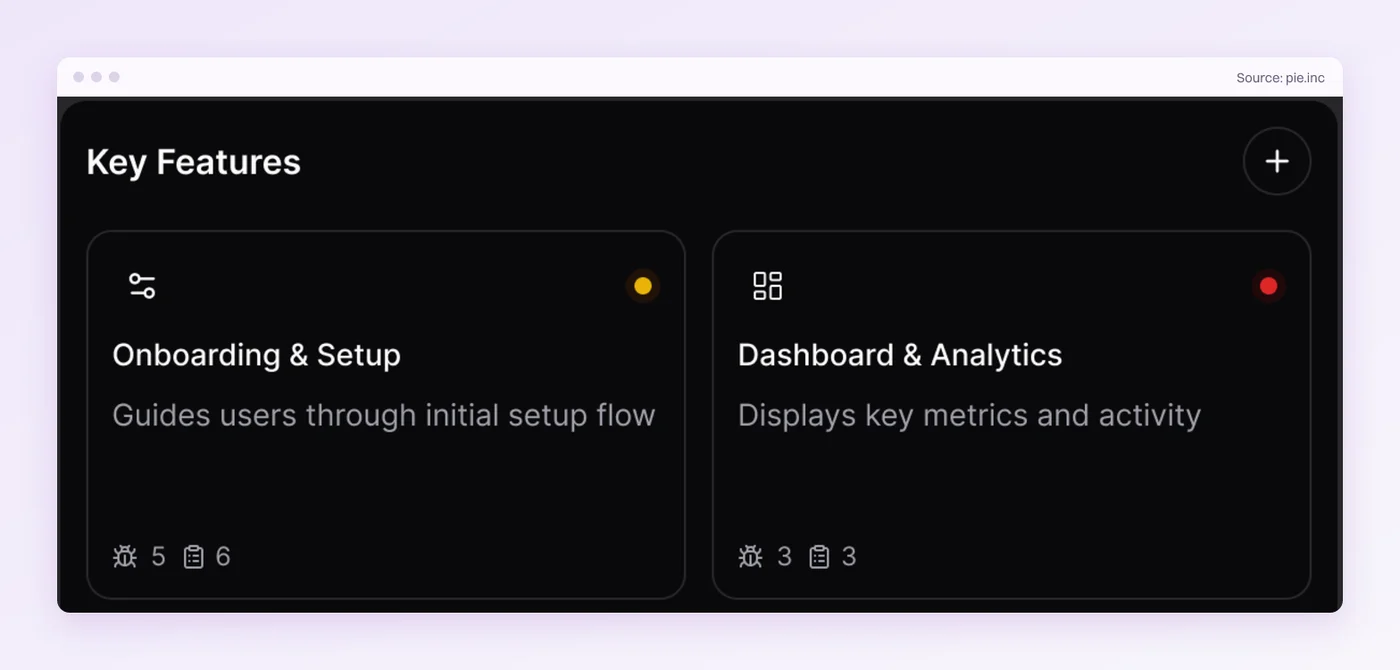
Pie is the autonomous option, and autonomous means something specific here. Point it at your web app or mobile build, plus a test login, and Pie’s agents explore the flows they can reach the way a user would. From that run they generate a baseline regression suite before anyone on your team writes a test. Your team keeps the judgment, and the grunt work of finding flows and rerunning tests goes to the agents.
A button moves, and a selector-based suite turns red. It executes vision-first, reading the rendered screen, so a moved button it still recognizes can require no locator repair. When a flow changes on purpose, you edit the steps that should change or have the agents rediscover the affected tests.
What sets it apart:
- Plain-English custom tests for the edge-case flows you want to define yourself, the same natural-language authoring the plain-English AI testing tools are known for
- Import the test cases you already keep as a CSV list, so a switch does not start from a blank page
- Vision-first execution with self-healing that can re-locate an element after a UI change, so you author supported tests without writing or maintaining selectors
- One platform for web apps in a browser and native iOS and Android apps on simulators and emulators, with real devices available on demand
- With repo access and a preview URL or build upload, Pie can test your pull requests and prepare a proposed fix as a pull request for your team to review
Rating: 5.0/5 from 3 ratings on Gartner Peer Insights.
Pricing: Contact Pie for a quote.
Best for: Teams shipping fast, often with AI writing much of the code, that want agents to find the flows and no test scripts to write.
Trade-offs:
- Tests live in Pie as plain-English steps, so there is no Playwright code to take with you
Not for: Teams that want to own portable test code in their own repo.
2. mabl, Low-Code Automation You Own
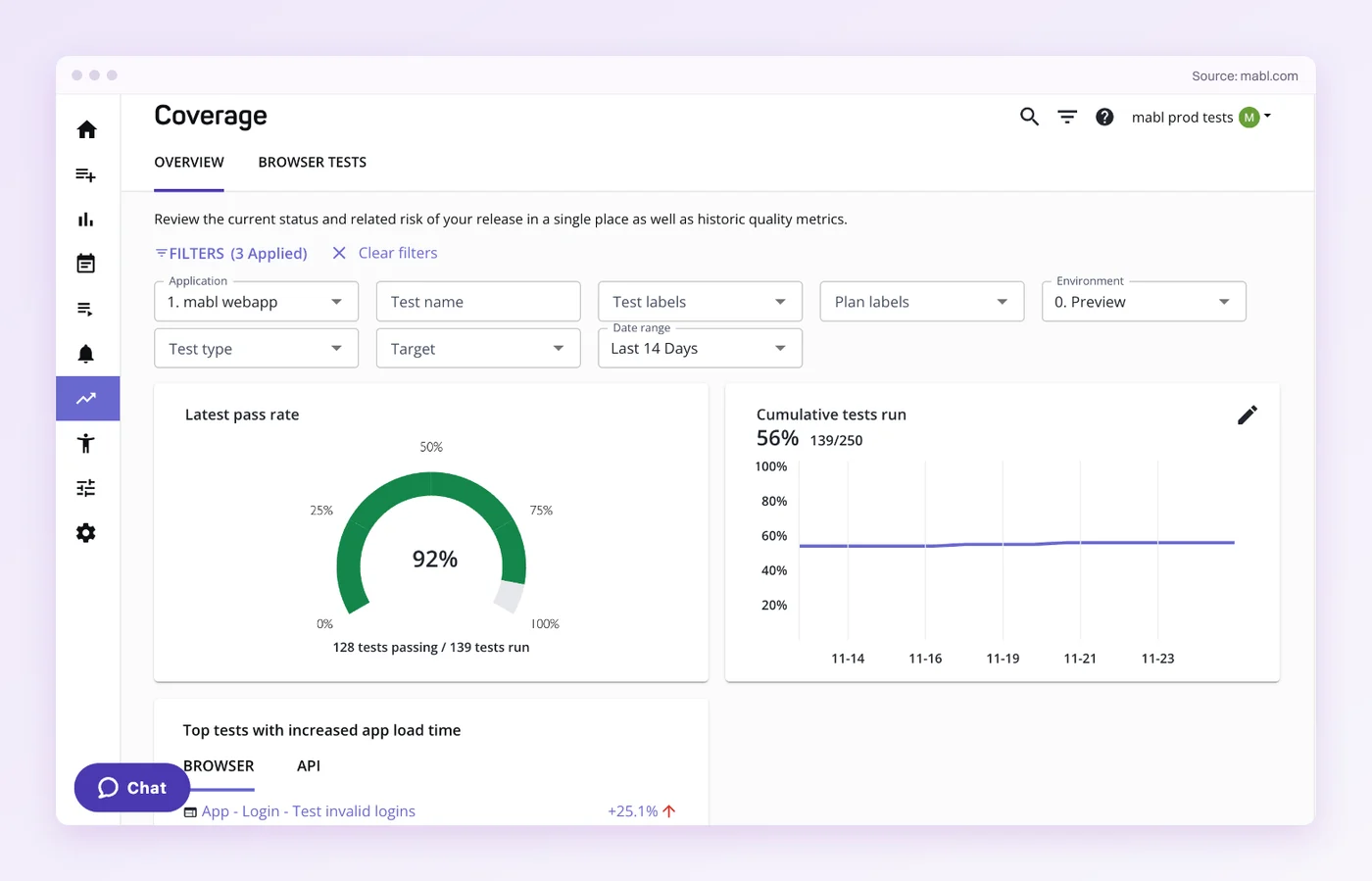
mabl is a low-code, AI-assisted test automation platform your own team drives as a cloud service. It earns its spot by taking you out of the managed-service contract. You own a tool instead of renting a team, so the bill stops scaling with someone else’s headcount.
Its auto-healing records attributes for each element, so a step can find its element again after a minor UI change. Against its nearest plain-English rival, how mabl stacks up against testRigor turns on who keeps the suite true after the first week.
Rating: 4.4/5 from 40 reviews on G2.
Pricing: Quote-based, with 500 credits a month for cloud test runs to start and local runs free.
Recurring strengths (G2 reviewers):
- An easy start, with a UX reviewers call smooth
- Low-code recording that non-technical staff can pick up
Recurring complaints (Capterra reviewers):
- A Trainer that some reviewers find finicky when editing or deleting steps
Best for: In-house QA teams after low-code authoring with auto-healing.
Not for: Teams that want testing off their plate, since you own authoring and upkeep.
3. testRigor, Plain-English Test Authoring
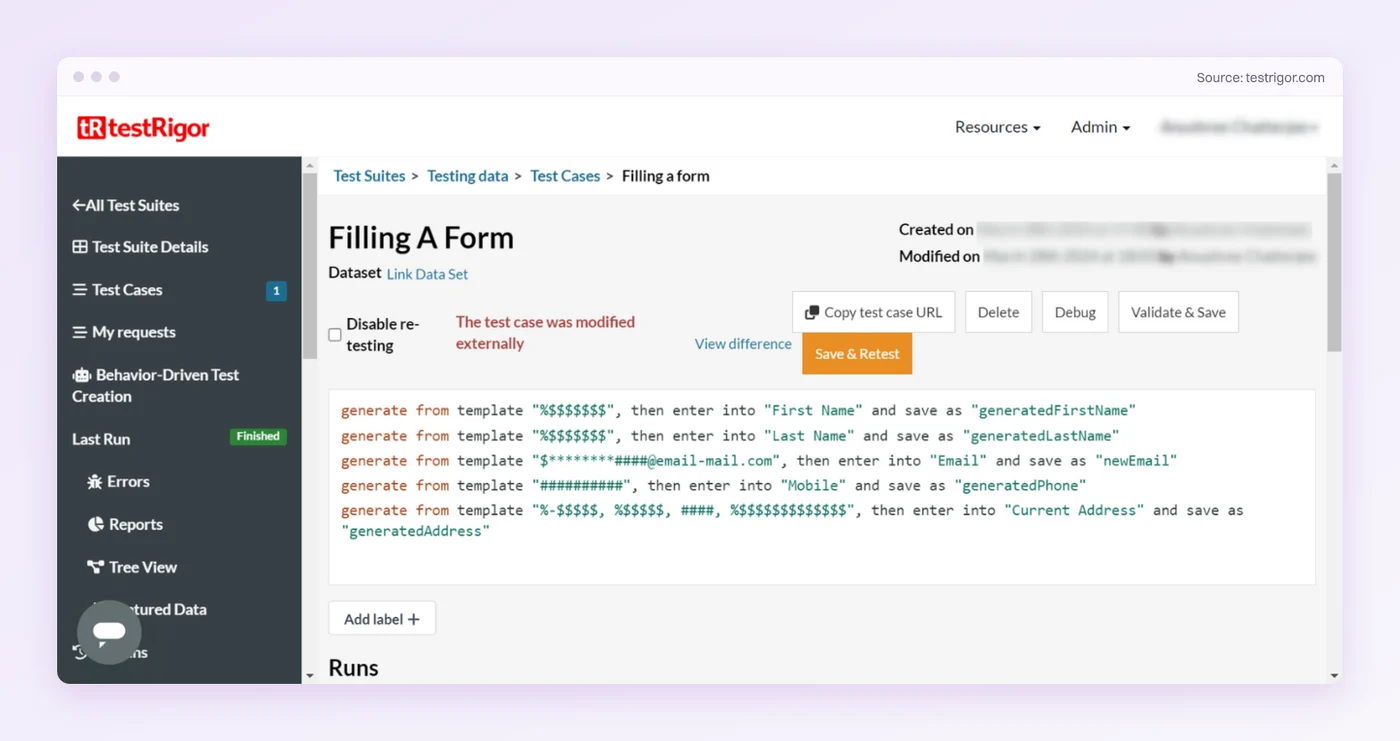
testRigor lets you write tests as plain-English statements like “click Login,” so authoring opens up to non-engineers. It goes after the other half of the QA Wolf problem, the wait. Anyone on the team can add or fix a test without queuing behind a specialist. Its generative AI can draft tests too, and your team owns each one after that.
Rating: 4.6/5 from 47 reviews on G2.
Pricing: Free forever for public open-source projects. The private plan starts with a two-week trial, and Enterprise is custom-priced.
Recurring strengths (G2 reviewers):
- Plain-English authoring that opens test writing to non-engineers
- Responsive customer support
- Step-by-step screenshots and recordings that make failures easier to debug
Recurring complaints (G2 reviewers):
- Cost that grows hard to justify at a large test count
- Less flexibility for complex scenarios, and an interface some find cluttered
Best for: Mixed teams where non-engineers write tests in plain English.
Not for: Teams expecting tests written and kept up for them.
4. Rainforest QA, No-Code Tests You Run or Hand Off
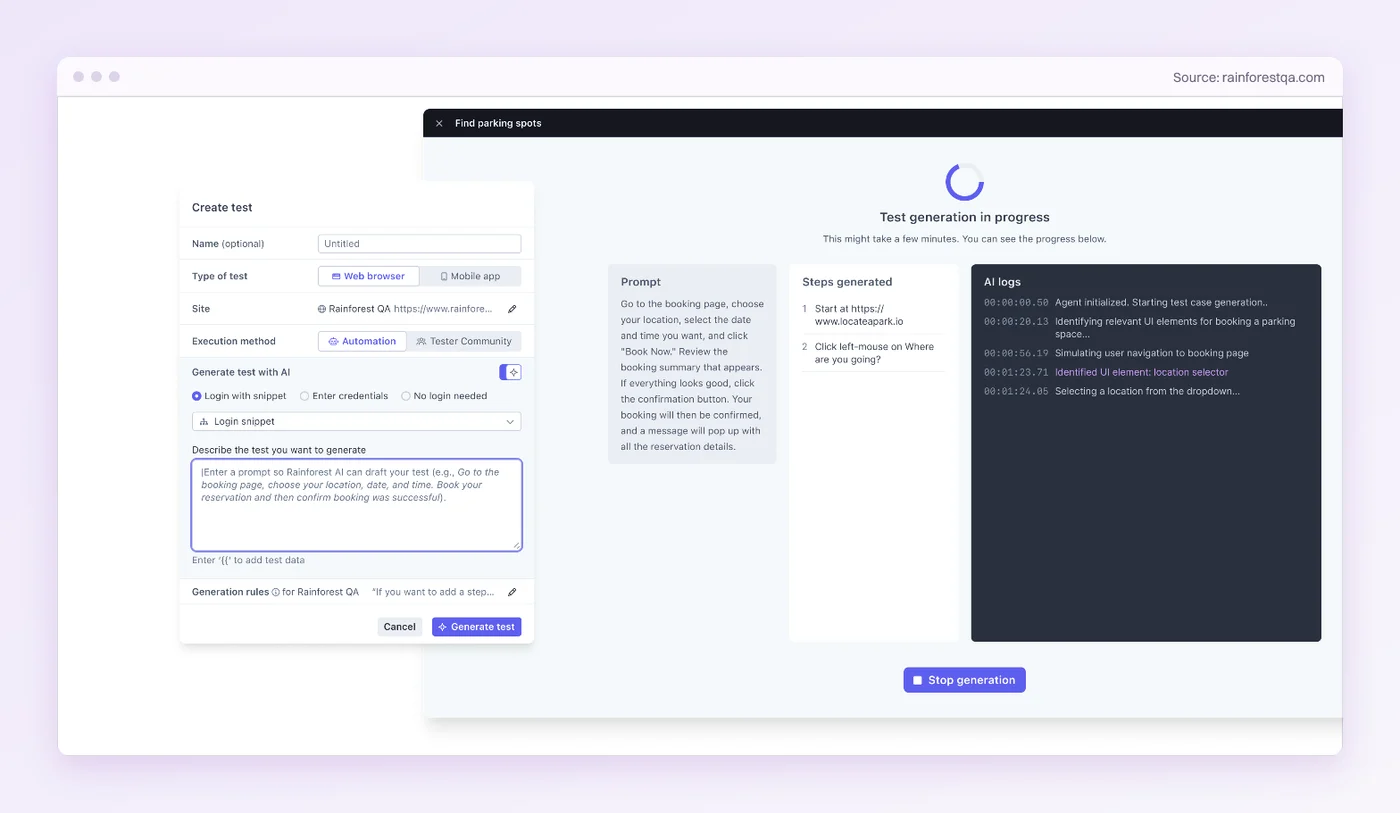
Rainforest QA is a no-code automation platform with AI throughout. Its AI test planner scans your product for flows to cover, and a URL plus a prompt is enough to draft ready-to-run tests. AI updates those tests when your app changes on purpose, and the suite runs on Rainforest’s cloud of virtual machines.
It makes this list as the one alternative here that sells both answers under one roof. Run the platform yourself, or hand the suite to a dedicated Test Manager who writes and maintains it for you.
Rating: 4.3/5 from 168 reviews on G2.
Pricing: Custom quotes, based on test volume, execution frequency and feature scope.
Recurring strengths (G2 reviewers):
- No-code authoring that technical and non-technical staff can both use
- Quick onboarding for anyone who joins the team
- Detailed insight into what failed and why
Recurring complaints (G2 reviewers):
- A troubleshooting interface some reviewers find confusing
- Reporting that reviewers call less intuitive than they want
Best for: Teams that want no-code, AI-drafted tests, with the option of handing the suite to a Rainforest Test Manager.
Not for: Teams that want a simpler troubleshooting view, which some reviewers find confusing.
5. Testsigma, Plain-English Automation Across Web, Mobile, and API
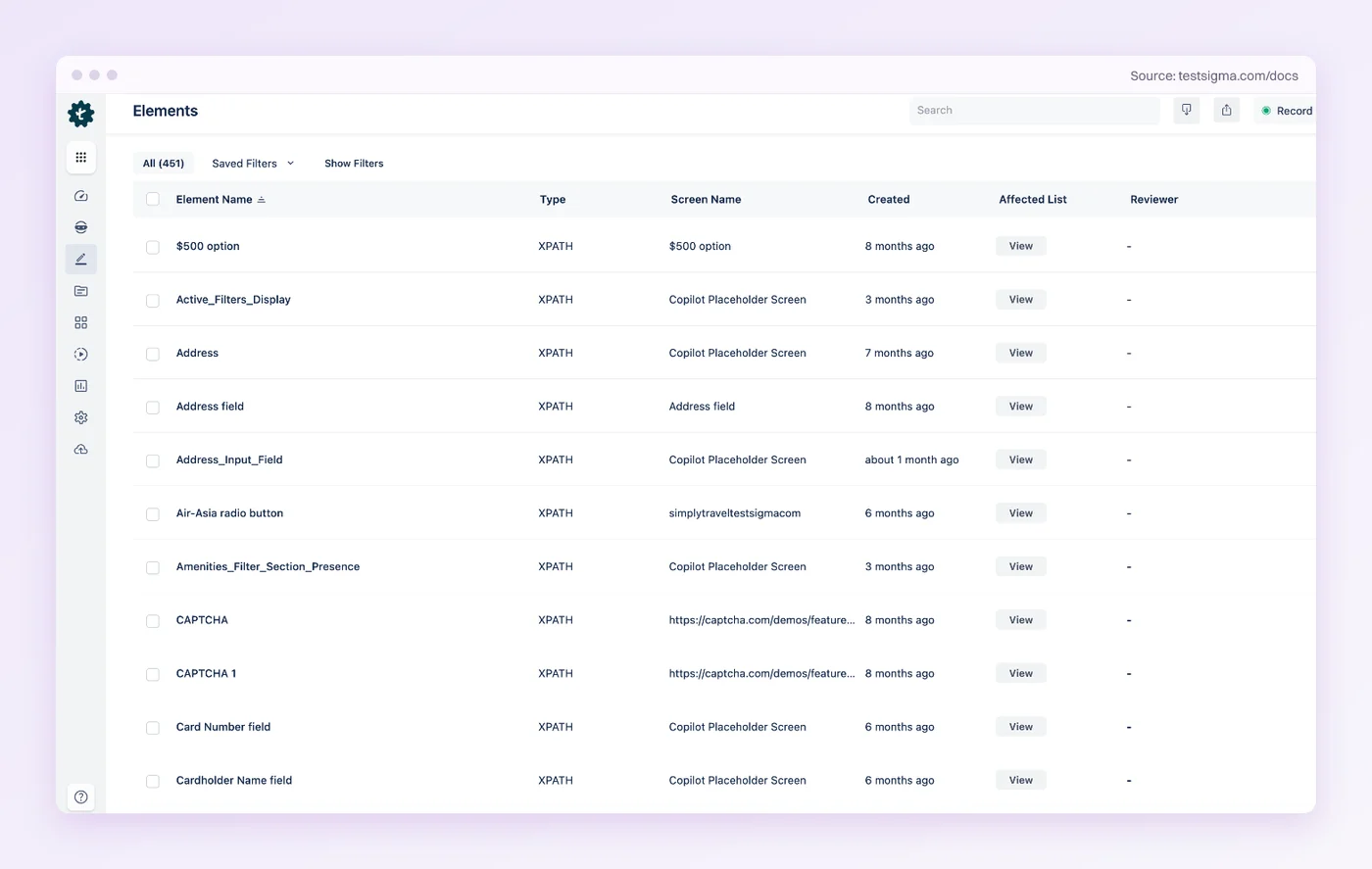
Testsigma is a low-code platform where tests are plain-English steps, and one interface covers six surfaces, from web and mobile to SAP. It builds automated tests from a Jira ticket, a recording or a prompt, and its agents map each code change and generate tests for it. Like mabl, it takes the managed contract off your books, then reaches further than most tools here.
On paper it reads close to Pie, since both take plain-English tests. The difference sits underneath. Each step that acts on the page uses an element stored in Testsigma’s Elements repository with a locator such as an XPath, and healing means updating that locator. Testsigma’s closest plain-English rival is testRigor, and testRigor vs Testsigma comes down to no locators against locators that heal.
Rating: 4.4/5 from 131 reviews on G2.
Pricing: Pro and Enterprise plans, both custom-priced.
Recurring strengths (G2 reviewers):
- An easy start with plain-English test creation
- Well-rated customer support
Recurring complaints (G2 reviewers):
- Complex scenarios that need code, where customization falls short
Best for: Teams happy to own the authoring in exchange for one plain-English tool across web, mobile, and API.
Not for: Teams that want tests written and maintained for them.
6. MuukTest, Managed QA on Its Own AI Platform
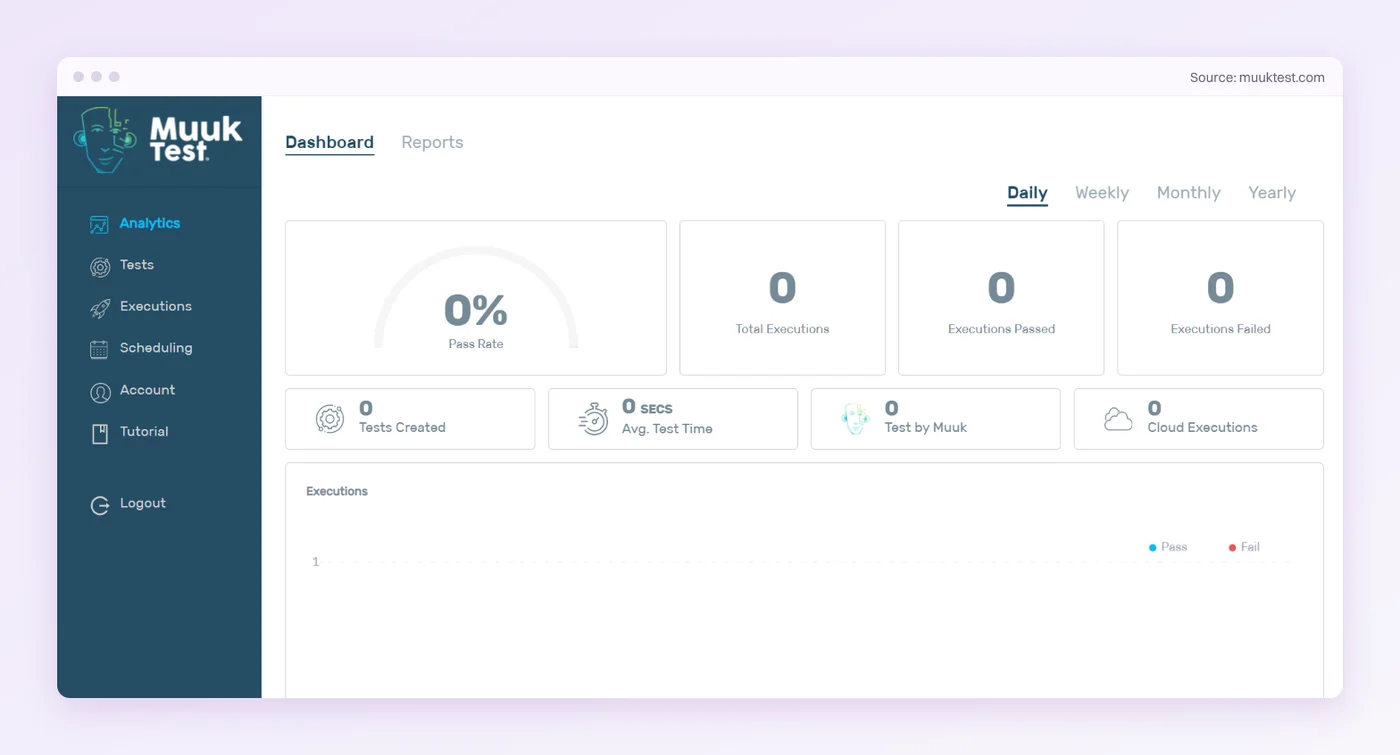
MuukTest is the alternative closest to QA Wolf’s managed model. Its QA engineers run your end-to-end testing on MuukTest’s own AI platform, so the work leaves your team the same way it does today. It makes the list for buyers who like being hands-off and want a second managed option at the renewal table.
What the packages include:
- Automation, Maintenance and Design agents, plus test infrastructure, bug reporting and QA insights
- A test engineer and a dedicated QA manager on the Full Service package
- A target of 80% test coverage on Automation Starter and 95% on Full Service QA
Rating: 4.5/5 from 27 reviews on G2.
Pricing: Outcome-based packages, quoted after a scoping session.
Recurring strengths (G2 reviewers):
- Takes on manual and automated testing, letting small teams add coverage without hiring
- A responsive team that reviewers say feels like part of their own
- Frees the in-house engineering team to focus on core product work
Recurring complaints (G2 reviewers):
- A UI some reviewers find clunky
- Reporting dashboards they want more granular
Best for: Buyers who like QA Wolf’s managed model and want a second managed option to compare.
Not for: Teams that want to own and run the testing tool themselves.
7. BrowserStack, Infrastructure and Breadth
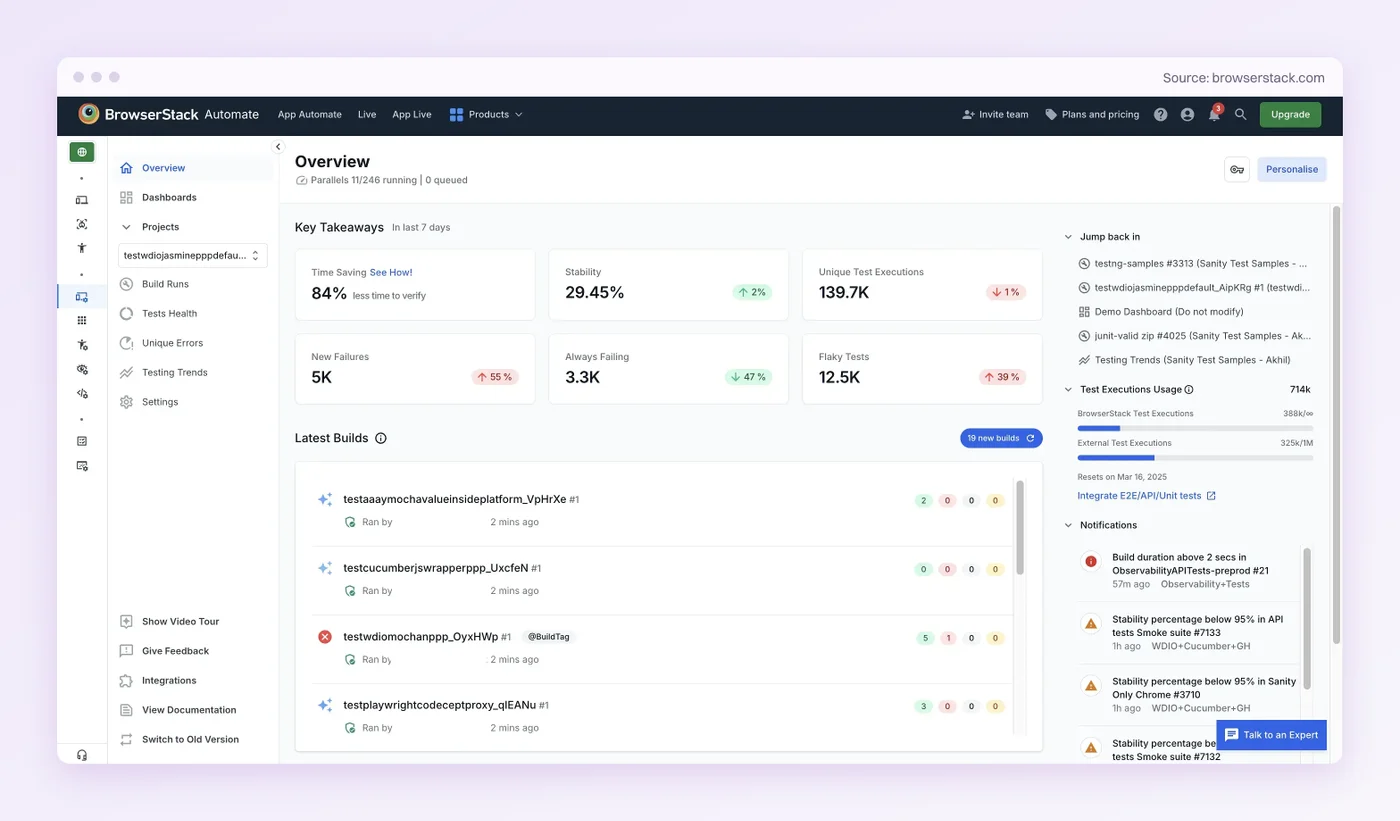
BrowserStack is testing infrastructure, thousands of real devices and browsers, with low-code tooling on top. Its AI agents, launched in June 2025, include a Self-Healing Agent that fixes failures caused by UI changes and a Test Case Generator Agent that turns requirements into test cases. It is on this list for a different reason than the rest. Some teams who shortlist QA Wolf need coverage across environments more than someone to write tests, and that is the shortfall BrowserStack fills.
Rating: 4.4/5 from 3,362 reviews on G2.
Pricing: Published per-product plans on BrowserStack’s pricing page, priced by the number of parallel tests.
Recurring strengths (G2 reviewers):
- Real devices and browsers on demand, with no hardware to buy
- Runs your existing Selenium and Cypress suites, with smooth CI/CD integration
Recurring complaints (G2 reviewers):
- Cost that climbs with parallel sessions, especially for smaller teams
- Sessions that lag or disconnect at busy times
- A steep learning curve for advanced setups
Best for: Teams whose real need is device and browser breadth, not authoring.
Not for: Teams whose bottleneck is writing and maintaining tests, not device access.
8. Autonoma, Source-Available and Self-Hosted
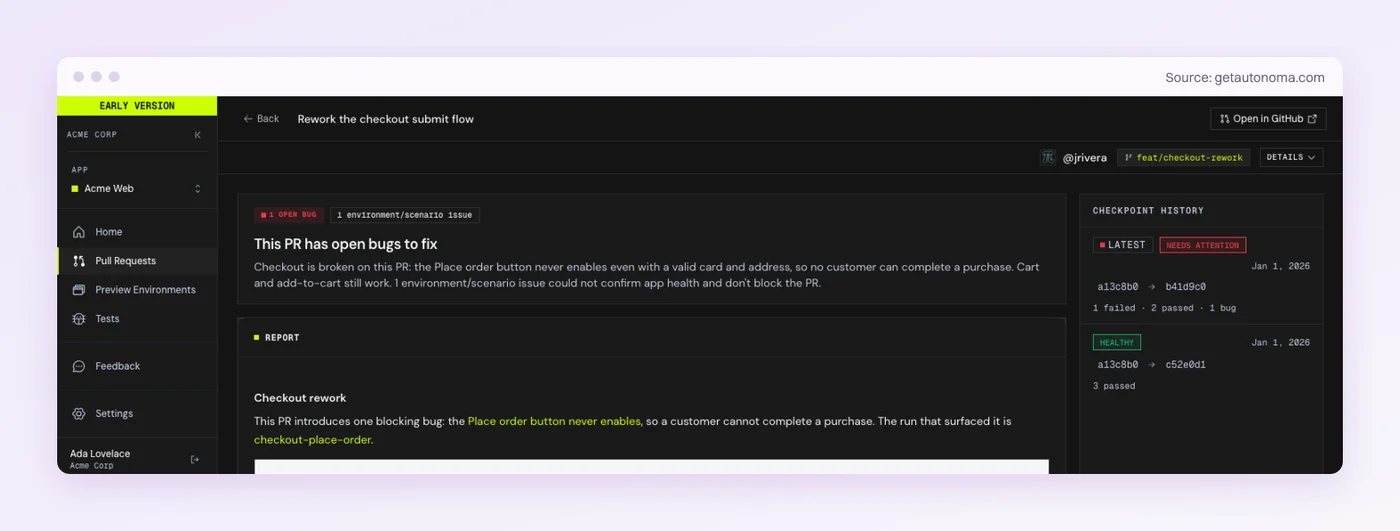
Autonoma is a source-available platform whose AI agents read your codebase and write natural-language tests from it. Each pull request gets a run against a fresh preview deployment, and the agents work from screenshots of the page. It takes a software-first route close to Pie’s, then hands you the keys. Self-host it and your team runs the infrastructure, which is real operational work.
Pricing: The source is public on GitHub under the Business Source License.
Strengths:
- Tests written from your codebase, which suits teams that already live in pull requests
- A run against a fresh preview deployment of every pull request, with problems raised on the PR itself
- Source you can read, change and run on your own infrastructure
Trade-offs:
- Self-hosting means running PostgreSQL and Redis yourself
- It is licensed under the Business Source License, not open source, until it converts to Apache 2.0 on March 23, 2028
Best for: Engineering teams set on an agentic stack they self-host and control.
Not for: Teams without the ops capacity to run and update a self-hosted testing stack.
Coverage That Scales With Code
Point Pie at your app. Watch its agents map it and build the suite.
How to Choose Your QA Wolf Alternative
Four questions, answered in order, narrow eight options to the one or two worth a trial. Authoring a test is a one-time cost. Maintaining it is forever.
- Own it, hand it off, or automate it? Each answer points to a different group.
- Own it with mabl, testRigor, Testsigma or the Rainforest QA platform: your team owns the tests, and the tool’s AI helps keep them current.
- Hand it off to QA Wolf’s managed tier, MuukTest or a Rainforest Test Manager, and a vendor’s team does the work.
- Automate it with Pie or a self-hosted Autonoma, where agents generate the tests.
- How fast does your product change? If you ship daily, Pie’s agents build the baseline suite themselves, and existing tests rerun on each new build once auto-run is set up. With repo access and a preview URL or build upload, Pie can also test your pull requests. Testsigma’s agents generate tests for each code change, and Autonoma runs on a preview of every pull request.
- What is your real budget at scale? Price every option at your two-year test count rather than today’s. QA Wolf’s Platform publishes per-run prices, so it is the easiest to model, and the quoted options will price a projected count on request.
- Do you ship web, mobile, or both? Separate tools for web and native mobile mean two places to maintain. Testsigma and Pie both cover web and native iOS and Android apps from one platform.
Managed vs In-House vs Autonomous QA
Strip it down and every option lands in one of three answers to who writes the tests, and each answer sets what your team keeps up as the suite grows.
| Model | Who writes the tests | What your team keeps up | Examples |
|---|---|---|---|
| Autonomous QA | AI agents, with your team reviewing | Steps you edit when behavior changes on purpose | Pie, Autonoma |
| Managed QA | A services team, with AI tooling | The test cases you hand over, and the bugs it files | QA Wolf’s managed tier, MuukTest, Rainforest Test Managers |
| In-house automation | Your team, with low-code or AI help | Your scripts or steps | QA Wolf Platform, mabl, testRigor, Testsigma |
The model decides who is on the hook when the UI changes. Managed and in-house both put a person on the repair, whether the vendor’s or your own. QA Wolf’s new agent now takes some of that work off its engineers. Autonomous QA changes what there is to repair, and selector upkeep is the cost that keeps automated testing expensive over the years.
Decide Who Owns the Suite Before the Renewal
QA Wolf is a strong answer, and its new agents do more of the writing and repair than a year ago. You end up with a code suite that someone keeps in step with your UI, quoted on the tests you need or priced per run.
When your team ships faster with AI writing the code, that suite grows with every release. The alternatives split on who keeps it current.
Pie moves that work into software. Its agents explore your app and build the suite. Because Pie runs it vision-first, you author supported tests without writing or maintaining selectors. When your app changes at 5pm on a release day, who fixes the broken tests, and how long do you wait?
Let the Agents Find the Flows
Bring your app and a test login. See what the agents find.
Frequently Asked Questions
QA Wolf sells two things. Its Platform lets your team run QA Wolf's AI agents, which write open-source Playwright and Appium tests, and you pay per test run.
Its Coverage-as-a-Service tier adds QA Wolf engineers who maintain your tests and investigate failures. Either way, the test code is yours to export.
It depends on who you want maintaining the tests. Pie fits teams that want agents to explore the app and build the suite, without writing or maintaining selectors.
mabl, testRigor and Testsigma suit teams that own their tests. MuukTest and Rainforest QA sell managed tiers, and BrowserStack covers device breadth.
QA Wolf's Platform starts at $1 per web test run and $2 per mobile or desktop run. Its managed tiers are quoted by the tests you need, and Vendr puts the median contract at $83,100 a year.
MuukTest and Rainforest QA price by custom quote. For Pie, contact Pie for a quote.
Both. The Platform is a tool your team drives, with agents that write Playwright tests from a prompt, billed per run.
Coverage-as-a-Service is the managed side, where QA Wolf engineers maintain your tests and investigate every failure within 24 hours. mabl, testRigor and Testsigma are tools only.
No. The work changes shape instead. Writing and rerunning test scripts is the part that automates first, and agentic platforms like Pie take that on.
The judgment stays with people, from deciding what correct means to signing off on a risky release.
Yes. QA Wolf writes web tests in open-source Playwright and mobile tests in Appium, and the code is yours to export.
Those tests find elements through locators, so when the UI changes someone repairs them, either a QA Wolf engineer or its AI Investigation agent.
Partly. Your QA Wolf tests are exportable Playwright and Appium code, so you keep them, and someone still maintains them.
On Pie, agents explore the app and build a baseline suite first. You then add the flows you care about as plain-English tests or import your test case list.
QA Wolf gives you Playwright and Appium code, written by its agents and engineers and repaired when the UI changes. Pie's agents explore your app and build the suite, and you author supported tests without writing or maintaining selectors.
QA Wolf fits better if you want test code in your own repo.
Spent a decade in B2B SaaS sales before building Pie. Now obsessed with helping engineering teams ship without the fear of breaking things. LinkedIn →