Is Appium Dead in 2026? What Its Vital Signs Show
Appium keeps getting declared dead. Its 2026 releases, commits, downloads and funding say otherwise, and they show which teams have a real reason to move on.

Appium’s loudest obituary is a Medium post titled “Appium is DEAD”, published on August 21, 2025. Appium 3 had shipped three days earlier. Since that release, the project has put out 18 more stable releases and a 4.0 beta that’s in testing now.
Dead is the wrong diagnosis. Appium 1 is gone, and so is the old desktop app, but the project passes the checks you’d run on any dependency you’re about to bet on. The question worth asking in 2026 is which teams should stay on it and which should move, and that turns on who maintains the tests.
What you’ll learn
- What Appium’s release record, commits, downloads and funding show in 2026
- Which parts of Appium really did die, and what to upgrade
- Where the “Appium is dead” claims come from
- Which teams should stay on Appium, and which should move
Is Appium Dead in 2026?
No. Appium 3.0.0 shipped on August 18, 2025, version 3.8.0 followed on September 24, 2026, and a 4.0 beta has been in testing since September 19, with its scope tracked in an open “Appium 4” issue. Appium 3 was a cleanup on purpose. Its announcement says the main idea was “to clear out old cruft so that Appium can be leaner moving forward.”
Credit to project lead Jonathan Lipps and the maintainers for choosing a cleanup over another rewrite. A major version with few breaking changes is what mature infrastructure ships. Three things did die, though, and they explain most of the confusion.
- Appium 1: The last 1.x release, 1.22.3, came out in March 2022, and the 1.x documentation now carries a deprecation notice.
- Appium Desktop: The old GUI app’s repository is archived, its last release shipped in May 2022, and its README points users to Appium Inspector.
- Appium 2: The last 2.x release, 2.19.0, came out on June 1, 2025. The current XCUITest driver and UiAutomator2 driver only work with Appium 3, and the project’s README says the team “only provides support for the most recent version of Appium.”
If you’re on Appium 2, the migration guide calls Appium 3 “a smaller upgrade with fewer breaking changes.” If you’re on Appium 1, plan for the bigger jump to the driver-and-plugin model that 2.0 introduced. Either way, put the upgrade on this quarter’s plan.
Appium’s Vital Signs in 2026
Score Appium the way you’d score any open-source dependency before adopting it, and it comes back healthy on each check. Only one reading carries a risk, and most people skip it.
| Vital sign | Reading | What it tells you |
|---|---|---|
| Release cadence | 15 stable releases in the 12 months to October 9, 2026, and no gap longer than 79 days since 2.0 shipped in July 2023 (npm registry) | Steady shipping, with no drought since 2023 |
| Commit activity | About 1,100 commits in the 52 weeks through the week of October 4, 2026, with at least one every week (GitHub) | Work lands every week |
| Leadership | 16 committers, led by a four-person Technical Committee whose members “represent different companies” (GOVERNANCE.md) | Leadership spans several employers |
| Foundation | An Impact Project of the OpenJS Foundation (project history) | A neutral home outside any one vendor |
| Funding | BrowserStack and TestMu AI (formerly LambdaTest) are Strategic Partners, TestMu AI also donates engineering time, and Open Collective shows an estimated annual budget of $56,572 (Open Collective) | Its biggest backers sell Appium testing |
| npm downloads | 5.51 million in September 2026, up from 1.93 million in September 2025 (2026, 2025) | Downloads almost tripled in a year, CI installs included |
| Stack Overflow share | About 3.6 Appium questions per 10,000 asked in 2025, roughly the share it has held every year since 2020 (Stack Exchange API) | Steady interest on a shrinking site |
| Device clouds | AWS Device Farm runs Appium 3 by default on its macOS Tahoe host, and Sauce Labs ships quarterly Appium 3 bundles (AWS, Sauce Labs) | The big grids are shipping Appium 3 |
| AI tooling | Appium’s maintainers publish appium-mcp, a Model Context Protocol (MCP) server that gives AI assistants tools for Appium automation, with version 1.97.1 out on October 12, 2026 (appium-mcp) | AI assistants can already drive Appium |
The funding row is the one I’d read twice. Appium’s sponsors page says its development is made possible “entirely by donations of time and money,” and its top partners are device clouds that sell hosted Appium testing. Companies that sell Appium sessions have every reason to keep Appium healthy. That’s the strongest argument against the obituary, and it’s also the risk to watch, because if those sponsors changed course, Appium’s pace would change with them.
The Stack Overflow trend gets misread. Appium-tagged questions there fell from 1,025 in 2019 to 39 in 2025, which looks like a collapse until you check the whole site. The site itself went from 1.76 million questions in 2019 to 109,030 in 2025.
Appium’s share dropped from about 6 per 10,000 questions in 2019 to roughly 3 to 4, and it has held there every year since 2020. Run the same checks on whatever you’d replace it with.
Why People Keep Calling Appium Dead
The death talk has three sources, and none of them means the code is failing. They come down to timing, a shared name, and incentives.
- The long beta: Between 1.22.3 in March 2022 and 2.0 in July 2023, Appium went 472 days without a stable release, its longest gap ever, while it shipped 45 betas and release candidates of 2.0. By March 2023, a thread on the official forum was asking whether Maestro would “start fading the Appium into dust.”
- A dead namesake: Appium Desktop, the old GUI, really is gone, and news of its retirement gets read as news about the server, which kept shipping.
- Vendor pitches: Many of the pages calling Appium dead come from companies selling a replacement, and Pie sells an alternative approach too. The Medium obituary’s evidence is one fintech’s switch and “a clear shift from Appium to Maestro among our clients,” and it closes with “Appium had its time. Maestro is the future.”
Maestro is a good tool. One company’s client list isn’t a census.
Look, the pain under the word is real. On Square’s platform side, we hammered on teams to build test coverage, and even when teams built it, maintaining it was a pain. Appium’s version of that pain is specific.
Appium’s locator strategies share names across platforms but map to different attributes. On Android, accessibility id reads an element’s content description. On iOS, where Appium works through XCUITest, it reads the element’s name. The same locator value rarely works on both unless developers set matching identifiers, so one UI change can mean two fixes, and Appium has no say in how often your UI changes.
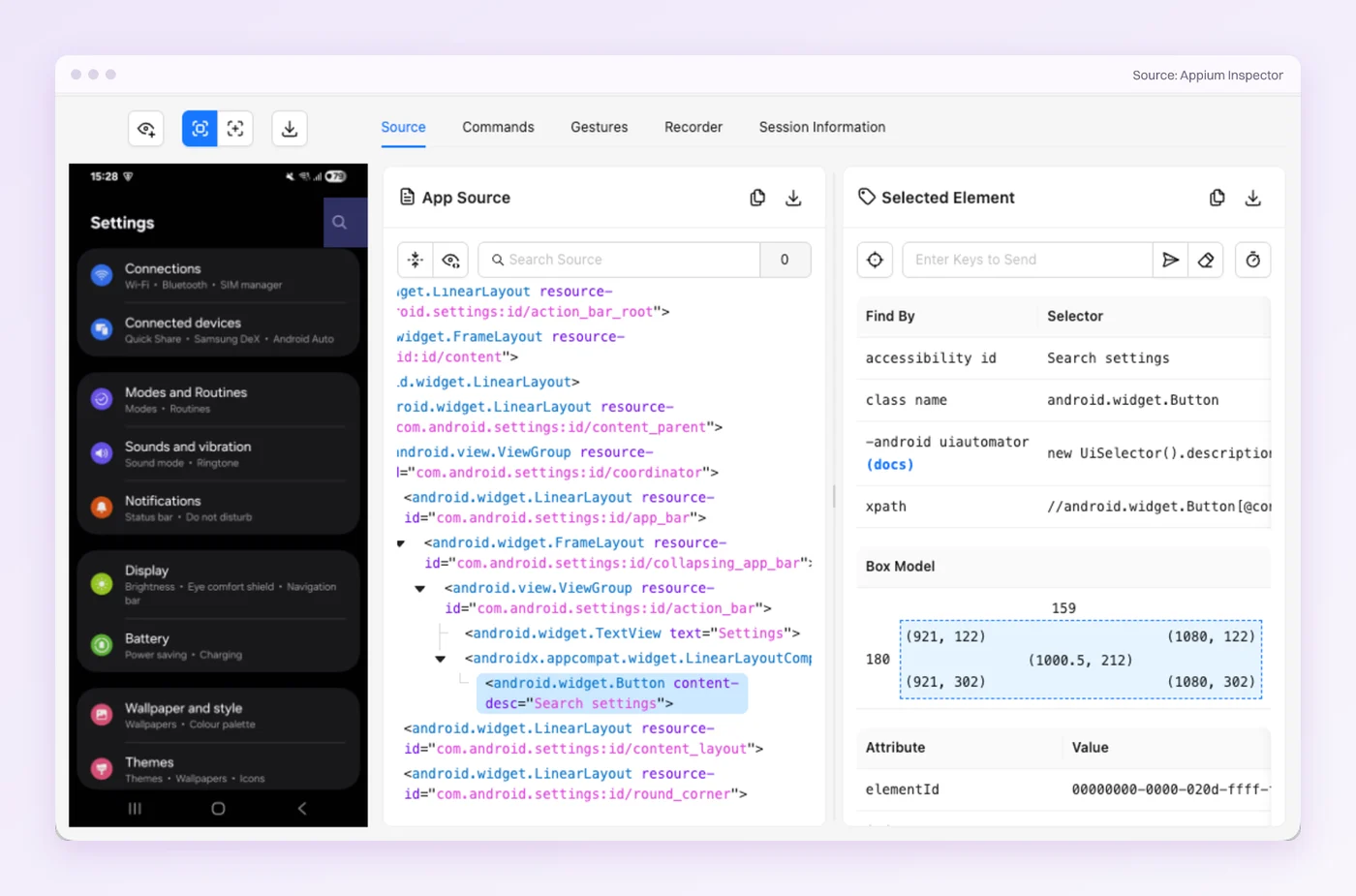
Diagnose the suite before you blame the framework.
Who Should Stay on Appium, and Who Should Move
Appium is one of several ways to approach testing mobile apps. Whether it’s the right one turns mostly on who writes your tests, and then on where they have to run.
Stay on Appium If
- Two platforms, one team: Appium’s stated goal is to make platform-specific automation available “under a cross-platform, standard API,” so one QA team can own iOS and Android suites in the language it already writes.
- Real hardware: Bluetooth, cameras and cellular behavior need physical devices, and the clouds that rent them, including BrowserStack, Sauce Labs and AWS Device Farm, document Appium support.
- Language choice: The Appium team maintains official clients for Java, Python, Ruby and C#, and WebdriverIO covers JavaScript.
- Beyond phones: Official drivers cover macOS and Windows apps plus the Safari, Chrome and Firefox browsers. A single Appium server can drive a desktop app and a phone.
Move, or Add Something, If
- Android-only engineers: Espresso is Google’s UI testing framework, and its docs say Espresso tests “run optimally fast.” When speed matters more than reach, Espresso beats Appium.
- iOS-only engineers: XCUITest is Apple’s own framework, and Appium’s iOS driver depends on it through WebDriverAgent, which links Apple’s XCTest framework. Writing in XCUITest directly removes a layer.
- React Native teams: Detox is a gray-box framework for writing end-to-end tests “in JavaScript for React Native apps,” and the differences between Detox and Appium start with that design.
- Simple flows: Maestro writes tests as plain YAML flows with automatic waiting built in, and gives up some of the flexibility of tests written in code. Maestro against Appium walks through that trade.
- Heavy upkeep: If maintaining the suite costs more than it catches, a new selector-based framework won’t fix it. Changing how tests find elements can, and that’s the axis to sort Appium alternatives on.
Where Pie Fits Next to an Appium Suite
Pie is built for that last case, and it’s meant to run beside the Appium suite you already have. Here’s how it works with a mobile app.
- Build upload: You upload an Android .apk or an iOS simulator .app.
- Exploration: The agents explore the app’s reachable, supported flows, using a working test login for anything behind sign-in, and generate tests from what they find.
- Plain-English tests: Each test is a list of plain-English steps that your team runs and edits without maintaining selectors.
A recognizable button that moves can need no locator repair at all. A redesign that changes what a flow does means editing that test’s steps. Mobile runs use iOS simulators and Android emulators, so validate real cellular and hardware behavior on devices.
Our advice to teams with a working Appium suite is to keep it running in CI. Put Pie’s autonomous QA platform beside it, and start with the flows nobody has scripted yet.
Upgrade First, Then Decide Who Owns the Tests
Appium isn’t dead. It ships every few weeks and has a 4.0 beta in testing, with device clouds that sell Appium testing among its biggest backers. Anyone still on Appium 1 or 2 should upgrade first, and the rest of the debate can wait.
Then ask who keeps the tests alive. If your engineers fix locators as fast as the app breaks them, stay where you are. If someone spends every release sorting real bugs from broken scripts, the framework was never your problem.
We built Pie for that second team. Leave the Appium tests that hold up where they are, hand Pie the flows whose scripts keep breaking, and put the hours you get back into the app.
Put Pie Beside Your Appium Suite
Keep the tests you trust. Let Pie cover the flows nobody scripted.
Frequently Asked Questions
Setup comes first. You install a Node.js server plus a driver for each platform, and iOS needs a Mac with Xcode in the standard setup.
The bigger cost arrives later. Locators map to different attributes on iOS and Android, so suites need steady upkeep as the app changes.
13 years building mobile infrastructure at Square, Facebook, and Instacart. Now building the QA platform he wished existed the whole time. LinkedIn →