What Is AI Testing? How It Works, Types, and Tools in 2026
What AI testing is, how it works, the five main types, and how the 2026 tools compare on the maintenance work they take off your team.

Every time your app ships, someone on your team fixes tests that broke when a selector changed while the product worked fine.
Tools that stop at drafting tests faster miss the expensive part. The expensive part is the fortieth rewrite, after a button moves or a designer renames a class. If the model is not fixing that, it is the same brittle workflow with a language model bolted on.
Judge every tool below on the work it removes, because AI testing only pays off when the model owns maintenance and discovery, not just authoring. By that measure, the field splits cleanly, and only the autonomous rung clears the bar.
What you’ll learn
- A precise definition of AI testing and how it differs from automation
- The mechanics of how models read an app, generate tests, and self-heal
- The five main types of AI testing and which tools use each
- Where AI testing falls short and how to set realistic expectations
What Is AI Testing?
AI testing uses large language models and computer-vision models to generate, run, and maintain software tests with little human authoring. The load-bearing word is maintain. Plenty of tools will generate a test. Far fewer will keep it alive when the interface shifts, and keeping it alive is where the cost lives.
Two Meanings, One Label
The phrase “AI testing” also names a second job, testing AI systems themselves, such as models, chatbots, and agents. The checks there cover data quality, bias, and whether an answer can be explained, and a model’s output varies from run to run in a way a login page does not. This guide is about the first job, using AI to test software.
The Difference That Actually Matters
The real question is whether a person or the model fixes the test when something breaks. In conventional automation, a human writes every step and every locator, and the machine only replays them. When the app changes, the human fixes it. In AI testing, a model does that work. It identifies elements by what they do or how they look rather than by a brittle internal ID, and it repairs itself when the app evolves. Remove the repair step and what is left is a faster way to write code that will still break next sprint.
Maintenance is the cost to anchor on. On any app under active development, the recurring spend goes to keeping existing tests alive as the interface moves, and that upkeep is the bill AI testing exists to delete. Even disciplined suites see flaky failures with no code change, and UI suites add a source of their own: tests coupled to implementation details that move with every release. A tool earns the label by attacking that coupling, not by writing the first draft faster.
How Does AI Testing Actually Work?
Under the hood, AI testing runs in four stages: perception, generation, execution, and healing. Each stage uses different machinery, and only some of it is a model. Vendors love to demo the first two. The last two are where the category earns its keep, and where most tools stop.
- Perception: A vision model or DOM parser ingests the live app and builds a structured map of what is on screen: buttons, fields, navigation, state. It lets a tool locate a Sign In button the way a person does, by shape, position, label, and context, instead of by a fragile XPath.
- Generation: A language model turns that map, plus the product’s intent, into concrete test cases. It infers that a login screen needs a happy path, an empty-field case, and a wrong-password case, then writes the steps. The same layer is what lets newer tools take a plain-English instruction like “test checkout with an expired card” and produce a runnable test.
- Execution: The suite runs against the live app. Nothing exotic yet. The model-written steps execute the way any automated suite would.
- Healing: A step fails because an element moved or a label changed. A healing model re-identifies the element by its learned pattern and continues, instead of throwing a hard failure and waiting for a human. Self-healing is the mechanic that splits AI testing from a recorder that replays clicks. The test keeps passing when the implementation moves and fails when the behavior breaks.
Stages one and two are now cheap. A capable model writes a plausible test in seconds. Stages three and four are the hard part, because healing has to be reliable enough that engineers stop reviewing every repair, and that is where the maintenance bill either disappears or lands back on a person.
Traditional automation asks “does the element with this ID exist?” AI testing asks “can the user still complete this task?” The first question fails every time a designer renames a class. The second keeps passing through that rename. A tool that nails generation but punts on healing is still living in the first question.
What Are the Main Types of AI Testing?
There are five types, and the gap between them is the whole story. Sorted by how much human work each one removes, they climb from “draft a test for me” to “build and maintain the suite for me.” The label “AI testing” hides that climb, so name the rungs precisely.
- AI test generation: Language models write test cases from the app, from requirements, or from a prompt. It shortens authoring and is the most common entry point, because it bolts onto existing frameworks like Playwright and Selenium. Playwright now ships its own planner, generator, and healer agents, which write code into your repo for you to own and review. Generation removes the least durable cost, since authoring was never the recurring tax.
- Self-healing tests: Models detect when a locator breaks and repair it by matching the element’s learned pattern. It goes after the real bill, the recurring work of keeping tests alive. Self-healing has become a headline feature across the major AI testing platforms.
- Visual AI testing: Vision models compare what a screen renders against a baseline, catching layout breaks, overlaps, and rendering regressions that DOM assertions miss.
- Autonomous test discovery: Agents explore the app on their own, map its flows, prioritize the high-risk ones, and generate a suite without a human specifying what to test. Discovery is the other half of the problem, the blank-page question of what even needs a test. Our deep dive covers how autonomous test discovery works.
- AI-assisted flaky-test management: Models read run history to detect flaky tests, classify root causes, and quarantine the unreliable ones before they erode trust in the suite.
Notice the slope. Type 1 saves you an afternoon once. Types 2 and 4 keep saving an engineer’s recurring attention. A tool that stops at type 1 is selling autocomplete. The ones worth paying for keep climbing. Sorting a vendor onto the right rung is its own exercise, and the question that does it fastest is who fixes the test when a button moves.
AI Testing vs. Traditional Test Automation
The two differ most in who carries the maintenance burden. Traditional automation puts every locator fix, every assertion update, and every flaky-test triage on the engineering team. AI testing moves that work to the model, which changes the economics of running a suite at scale.
They are not mutually exclusive, and AI testing can be adopted incrementally on top of an existing stack. But the differences are sharp enough to shape strategy.
| Dimension | Traditional Automation | AI Testing |
|---|---|---|
| Test authoring | Engineer writes every step and locator by hand | Model generates tests from the app or a prompt |
| Element identification | Brittle selectors (XPath, CSS, IDs) | Behavior and visual pattern, selector-independent |
| Maintenance on UI change | Manual fix for every broken locator | Self-healing re-identifies elements automatically |
| Coverage growth | Linear with engineer-hours | Agents can expand coverage without proportional headcount |
| Broken and flaky tests | Locator breakage after every UI change, plus timing flakiness | Locator-driven failures largely removed; timing and environment flakiness remain |
| Best for | Stable apps, deterministic API tests | Fast-changing UIs, frequent releases, broad coverage |
AI testing has tradeoffs of its own. Vision-based inference uses more compute than a selector match, and a sweeping redesign can break tests until their steps are regenerated. For teams shipping weekly against a changing UI, that tradeoff favors AI testing. On a frozen legacy app with a stable DOM, classic automation may stay the cheaper choice. AI does not always win. On a changing app, the maintenance math decides, so measure every tool against it.
What Are the Best AI Testing Tools in 2026?
The best tool depends on which type of AI testing you need, because the market has specialized hard. Some tools lead on visual AI, some on natural-language authoring, some on full autonomy. Below is a map of the notable 2026 platforms and where each is strongest, with a ranked shortlist in our guide to the best AI test automation tools.
Generation and self-healing are table stakes now, and all five platforms advertise both. What differs is where a test starts and how far mobile goes.
| Tool | Where Tests Start | Mobile Apps |
|---|---|---|
| Pie | It explores your running app and writes the tests | Native iOS and Android apps |
| testRigor | AI generates tests from a description or from production usage | Native and hybrid iOS and Android apps |
| mabl | Your description | iOS and Android apps |
| Applitools | A sitemap crawl on web, or a flow you walk through | Visual checks inside Appium, Espresso, and XCUITest scripts |
| Testim | Your description, or a recording | Native, hybrid, and cross-platform apps |
The question underneath the table is whether a planner explores your running app or generates from a prompt. Ask every vendor, because the answer separates deep coverage from shallow coverage.
Here is when to choose which:
- Choose testRigor when you want AI-generated tests and a device cloud built in for mobile. It also works with TestMu AI or BrowserStack for a broader range of devices.
- Choose mabl when you want agents that create, run, and maintain tests while your team sets the direction and guardrails. It covers iOS and Android apps.
- Choose Applitools when visual and layout regression is your primary risk. Eyes adds visual checkpoints to existing Appium, Espresso, or XCUITest scripts, and Autonomous builds web suites from a sitemap crawl.
- Choose Testim (now Tricentis Testim) when you want prompt-driven test creation and self-healing smart locators. Testim Mobile runs native and hybrid apps on virtual iOS simulators and Android emulators.
- Choose Pie when the bottleneck is the suite nobody has time to build, especially on mobile. Its agents explore your running app, native mobile runs on simulators and emulators, and the model owns discovery and maintenance.
Pairing a visual AI layer with a suite that builds and maintains itself is a reasonable stack. Paying for “AI” that stops at generation and hands the maintenance back is not.
Watch an Agent Write the Suite
See Pie explore an app and write its tests. Skip the blank page.
Where Does AI Testing Still Fall Short?
AI testing falls short wherever correctness is ambiguous and a human has not defined it. A model can confirm a checkout flow completes, but it cannot decide for you whether a 9.99 charge should have been 8.99 under a regional promotion. Business logic is not something a model infers from the screen. AI testing automates execution and maintenance. It does not replace judgment about what “correct” means.
Three limits stand out:
- Ambiguous acceptance criteria: If the spec is fuzzy, the model guesses. AI testing is strongest on well-defined user journeys and weakest on subjective or under-specified requirements.
- Environmental flakiness remains: Self-healing removes locator-driven failures, but it does not fix network timeouts, resource contention, or shared-state collisions between tests. They come down to sound test design, with or without a model.
- Trust and verification: A generated test you never read is a test you do not fully trust. The mature workflow is human-in-the-loop: the model does the labor, an engineer reviews intent and edge cases. When agents write the code and the tests, as on a software factory line, a check the agent can edit can’t vouch for its own work. As QA roles evolve, the skill that grows in value is specifying and verifying, not hand-writing scripts.
Set expectations there and AI testing delivers real value. Expect it to decide for you what matters, and it will disappoint. The autonomous rung wins on the right apps and not all of them, because it removes the labor, not the judgment.
Let Pie Own Discovery and Maintenance
Pie sits at the autonomous end of the spectrum. We built it on the claim that the model should own discovery and maintenance, the two parts engineers hate most. A Pie agent explores your app, decides what to test, and writes the suite. The tests are built to survive interface changes. Our agentic testing platform does this for web, iOS, and Android.
- Autonomous discovery: Pie explores the screens of your app, finds its key features, and writes test cases under each one. You review that map in Map your app and add what it missed.
- Selectors you never write: On mobile, tests find elements by what the user sees. On web, the agent drives a real browser the same way and reads the page code only where that is the more reliable signal. Nobody on your team writes or maintains a locator for supported tests.
- iOS and Android: Pie covers both in one platform, and mobile tests find elements by what the user sees, so you are not keeping two parallel sets of selectors in step. Each platform’s tests are checked against that platform’s own screens.
- Plain-English custom tests: For flows an agent cannot infer, like regional pricing or regulated workflows, you describe the test in plain English and Pie runs it alongside the discovered suite.
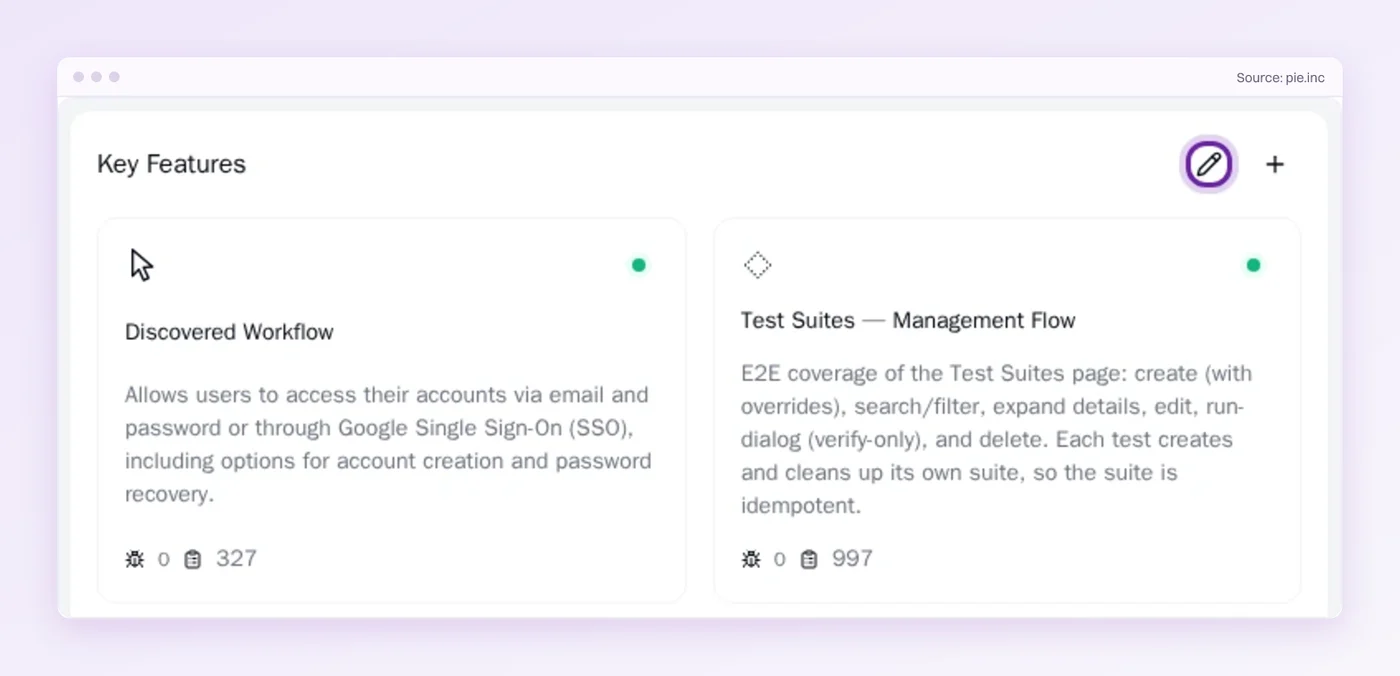
Pie works alongside your existing framework and your QA team, and replaces neither.
What AI Testing Delivers in 2026
AI testing is the use of machine learning to generate, run, and maintain tests. In 2026 it is less a single feature than a spectrum running from AI-assisted authoring all the way to suites that build and heal themselves. Generation is the baseline. The thing that separates a real tool from a sticker is whether the model also owns the recurring work: maintenance and discovery.
QA engineers keep the job and lose the parts nobody got into engineering to do, such as fixing selectors, rewriting tests after a redesign, and triaging the same flaky failure for the third time. The judgment about what to test and what “correct” means stays human.
Test every vendor on one question. What does it actually delete from your week? If the answer stops at “it writes the first draft faster,” keep looking.
Stop Maintaining Tests. Start Shipping.
Pie writes the suite, so your team ships instead of babysitting selectors.
Frequently Asked Questions
Eight years building search and delivery systems at Amazon. The kind of scale where flaky tests block billion-dollar releases. Now CTO at Pie, building AI agents that adapt when your UI changes. LinkedIn →